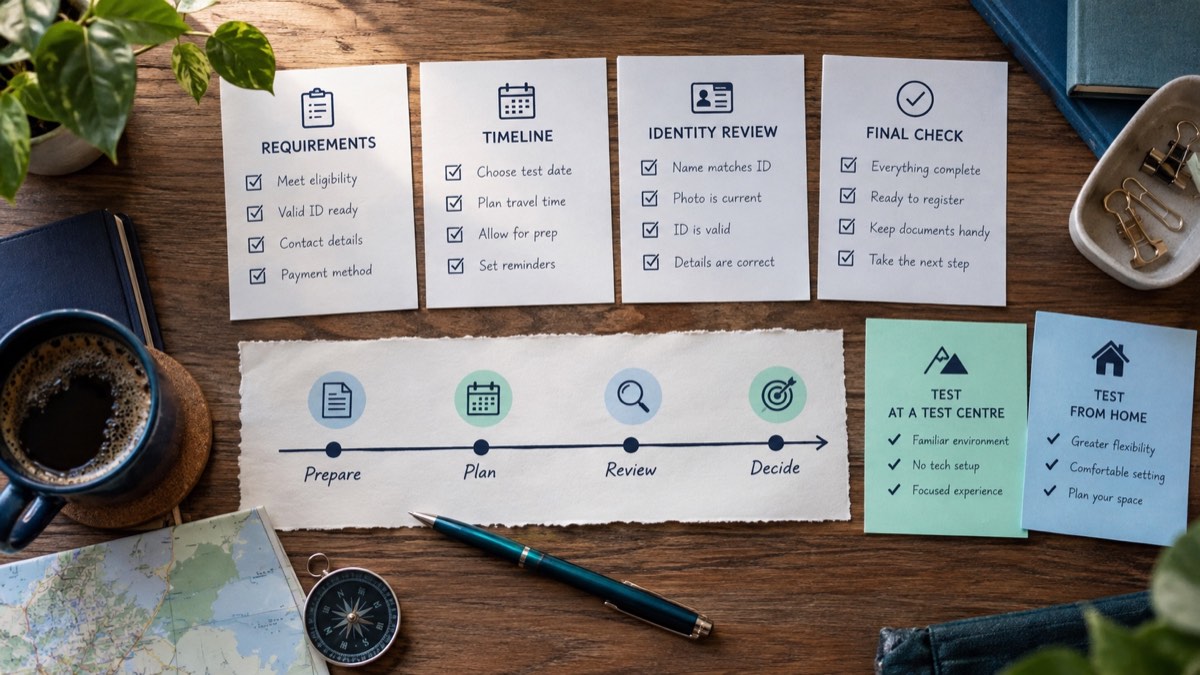
Registering for CELPIP is easier when you confirm the test you need, prepare your account and identification details, and understand the appointment conditions before you pay. A rushed registration can create avoidable problems: selecting a product that does not match an application requirement, choosing a centre you cannot reach, entering details that do not match your identification, or overlooking a deadline that leaves too little time for results and any next step.
This guide is a practical pre-registration checklist for CELPIP-General and CELPIP-General LS candidates. It helps you organise the decisions to make before entering an official registration flow. It does not replace CELPIP’s current policies, confirm that a particular institution accepts a score, or provide legal or immigration advice. Check the current official information for your location and purpose before booking. For a broader overview of CELPIP-General and General LS, test format and provider links, see our CELPIP exam guide.
Start with the requirement, not the calendar
Before looking for a date, identify why you need an English test. The answer could be an immigration process, a professional registration, a school or college application, employment, or a personal goal. Write down the receiving organisation, the programme or application route, and the deadline that applies to you.
Then confirm the precise test product required. CELPIP offers different test types, and they do not all assess the same skills. CELPIP-General assesses listening, reading, writing and speaking. CELPIP-General LS assesses listening and speaking. Do not infer the correct product from a friend’s experience or from a general statement that an organisation “accepts CELPIP.” The requirement may specify a product or purpose.
Ask the organisation a direct question if the policy is unclear: “For this application and intake, do you accept CELPIP-General or CELPIP-General LS, and are there any minimum scores by skill or result age limits?” Record the reply and its date. The receiving organisation sets its own evidence rules.
The official CELPIP overview explains the available test products and links to relevant test information. Use it as the starting point, then verify the exact requirement with the organisation that will use your result.
Confirm that the test matches your use case
Build a small requirement record before you create or use a registration account. Include the following:
- the organisation or authority receiving your result;
- the exact application, programme or purpose;
- the accepted CELPIP test product;
- any overall or skill-specific score requirement;
- whether results must be sent directly or uploaded by you;
- the latest date the result must be received;
- any rule about how recent the result must be.
Do not assume that a result accepted for one application is accepted for another. Requirements can vary by programme, regulator, route or intake. If you are applying to multiple destinations, make a separate row for each one. A single test choice may meet several needs, but confirm that rather than relying on a general comparison page.
If an organisation uses a score threshold, copy the wording exactly. Distinguish a required score in every skill from an overall score. If the policy gives a date by which evidence must arrive, note whether it means the result needs to be available, shared, or received by the institution. Those are different steps.
A candidate planning for two purposes might have one application that accepts CELPIP-General and another that asks for a different test or a different product. The safe next step is to confirm both requirements before purchasing, not to hope that an administrator will accept a close substitute later.
Decide whether General or General LS applies
CELPIP-General and CELPIP-General LS should be treated as distinct products. Select the one named in your confirmed requirement. A two-skill product is not automatically interchangeable with a four-skill test simply because both use the CELPIP name.
If your purpose is immigration or licensing, consult the relevant official route as well as the test provider. Some authorities identify the accepted test and version explicitly. If your purpose is academic admission, use the institution’s programme page or ask its admissions team. For employment or professional registration, consult the employer or regulator’s current policy.
Make the decision in writing: “I need [product] for [purpose], as confirmed by [source] on [date].” This simple note can prevent a last-minute product change based on a confusing search result.
Do not select a product just because it has fewer sections or appears more convenient. The best test is the one that satisfies the receiving organisation’s conditions and fits your preparation plan.
Check your identity document before choosing an appointment
Identification requirements deserve attention before registration. Read the current CELPIP identity rules and test-day guidance for the location where you will take the exam. Check the accepted document types, validity, name matching and any country-specific conditions.
Compare the identity details you plan to use with the details in your account and registration. Check spelling, order of names, accents or transliteration, date of birth, and any middle names or initials that appear. If your document has one name, multiple names, a recent change, or a spelling difference from another record, ask the official support channel how the registration should be completed before paying.
Do not copy a name format from a social media post or assume a centre employee can change it on test day. A test provider may have specific rules about identification and amendments. Resolve uncertainty through the official process and keep the response with your booking records.
Check that the identity document will still meet the rules on the actual test date. If a passport or other document is being renewed, replaced, submitted to another authority, or is close to expiry, clarify whether you will have an acceptable document in hand when you attend. Avoid making a booking decision based only on the document’s current status.
CELPIP’s official test day information explains identification and appointment-day requirements. Read the current page in full and confirm any question specific to your document with the provider.
Compare dates with the whole application timeline
A test date is one point in a longer chain. Work backward from the date the institution must receive evidence. Allow for the test appointment, result availability, sharing or reporting steps, and time to respond if something unexpected occurs. Confirm current result timelines with CELPIP rather than relying on an old forum estimate.
Use a calendar with at least four entries: application deadline, target date for evidence receipt, latest sensible test date, and a preparation checkpoint. This turns a broad deadline into a choice of test date that leaves time for both the result and any required submission steps.
A practical example: an applicant has a school deadline on the 30th. They should ask the school whether the score must be received by that date, then check the provider’s current result and sharing process, and work back to a test date that leaves adequate time. This is an illustration of the reasoning process, not a promise about processing speed.
If you are also considering PTE, IELTS, TOEFL or the Duolingo English Test, compare them only after confirming acceptance and score conditions for the exact application. Book Exam Online’s English test comparison guide can help structure questions, while the receiving organisation remains the source for its own requirements.
Choose a location you can realistically reach
Look at more than the city name. Confirm the exact centre address, available appointment date, travel route, journey time, expected traffic or transit limitations and any building access instructions. The test location shown during the official process is the important detail; a search page or map pin can be outdated or approximate.
Plan to arrive with a reasonable buffer. If the centre is unfamiliar, find the route in advance and identify a backup route. Check whether parking, public transit or building entry has restrictions. If you have accessibility needs, ask the provider what arrangements are available and what process or notice period applies.
The official CELPIP test date and location search is the place to check current appointment options. Availability can change. Verify the address and date shown for the specific registration before you complete payment.
Candidates travelling from another town should compare the cost and reliability of the full journey, not just the test fee. Consider the possibility of a delayed train, a long transfer, weather, accommodation, or a return trip after the appointment. A cheaper or earlier date may be a poor choice if reaching the centre creates a significant risk.
Prepare account information carefully
Use the official registration route linked by CELPIP. Before beginning, have the identity information you need, a reliable email address you can access, and a payment method accepted by the current registration process. Make sure your email account can receive the provider’s messages and that you know how to check spam or filtered folders.
Enter personal details slowly and compare each field with your identification. Check the date format and the order of given and family names. Avoid using nicknames, informal transliterations or a different email identity if the registration instructions call for legal details. If you see a field that does not fit your document, ask the provider before submitting rather than guessing.
Store your login details privately. Do not send your password, one-time code or full payment card information to an agent, friend or social media account. If you use an assisted booking service, ask what information it needs and whether you can complete sensitive account or payment steps yourself through the official provider. A legitimate helper should be able to explain the process without asking you to expose unnecessary credentials.
Review the amount and what this booking includes
Before paying, read the exact amount, currency and product name shown in the official CELPIP registration flow. Check that the selected test type, location and session match the choices you prepared. If an extra service or payment item appears, identify what it covers before proceeding. Do not use a price from an old screenshot or another country as the amount for your own appointment.
If you plan to use a voucher or code, check that the official checkout accepts it for the product and country you selected and shows how much it covers. A code or seller receipt by itself is not an appointment. Continue only when the checkout makes the amount due and the action being confirmed clear.
For questions about an existing appointment’s transfer or cancellation terms, use CELPIP’s current policy and account instructions; those rules are separate from the checks needed to choose a new test session. This checklist stays focused on preparing for a first registration.
Make a preparation plan before selecting the date
Choose a date that gives you enough time to prepare across the skills included in your test. Start with a diagnostic session using official sample or preparation materials. Note what is already manageable and what needs focused work. Then plan practice around your available hours, not an ideal schedule you cannot sustain.
For CELPIP-General, include listening, reading, writing and speaking practice. For CELPIP-General LS, plan for the skills in that product. Use official samples to become familiar with the task types and response expectations. Keep separate notes for content, timing, vocabulary, organisation and technical or test-day questions.
A simple weekly plan might include two skill sessions, one integrated practice session, and one review session. Adjust for work, school, family duties and the deadline. A realistic shorter routine is usually easier to maintain than an ambitious plan that collapses after a few days.
Avoid treating a practice score or one sample set as a guarantee of a future result. Use practice to locate a need and measure whether a specific routine helps. If your timeline is short, prioritise the skills that are required and the errors that appear repeatedly.
Use a pre-registration worksheet
Before you enter payment details, complete this worksheet:
Purpose: What application, programme or process needs the result?
Product: Which exact CELPIP test type is required? Where is that requirement confirmed?
Scores: Are there overall or individual skill minimums? Are any scores required by a separate deadline?
Identity: Which accepted document will I bring? Does every account field match it? Will it remain available and valid on test day?
Date: What is the latest date I can test while leaving time for results and reporting? Have I checked the current schedule?
Location: What is the exact centre address? How long does travel take? What is my backup route?
Terms: What rules apply to cancellations, transfers, refunds and late arrival? What is the complete price and currency?
Preparation: What will I practise each week? Which official materials will I use?
Records: Where will I keep the receipt, appointment confirmation, policy links and support replies?
If you cannot answer a material question, pause the registration flow and check the official source. This is a short pause to reduce an avoidable mismatch, not a reason to postpone indefinitely.
Two example decisions
Example one: a student applying to two programmes. One programme page says it accepts CELPIP-General, while the second has a general English-test page but no product details. The student confirms the first requirement from the programme page and emails the second admissions team with the exact product and intake. They compare deadlines after both replies. They do not assume that the first programme’s acceptance applies to the second.
Example two: an applicant with an identity-document question. The applicant notices that the account name field does not clearly match the format on their document. Before selecting a date, they read the provider’s current ID guidance and contact official support with a concise description of the discrepancy. They keep the response and follow the instructions. They do not test a guessed name format by purchasing an appointment and hoping the centre will resolve it.
These examples illustrate decision-making only. They do not establish a universal admissions, identity or booking outcome.
Have a short readiness note before you start
Keep one compact note with the requirement source, exact CELPIP product, intended location, ID question (if any), result deadline and the official registration page. Use it while completing the online steps so you can compare each choice with the reason you are booking. Avoid saving passwords or full card details in the note.
CELPIP says test centres do not process registration applications and points candidates to register online. Open the official test date and location search from CELPIP’s site, check the live session details and follow its registration prompts. Availability can change; the page you reviewed earlier is not a reservation.
Common mistakes to prevent
Choosing a product from a broad acceptance claim. Confirm the exact type for the specific purpose.
Booking before checking identification. Resolve name or document uncertainty through the official provider first.
Working backward from the test date instead of the application deadline. Include result availability and reporting steps in the timeline.
Selecting a centre based only on the city. Verify the exact address and the journey you will make.
Starting the checkout before the choices are clear. Verify the product, identity details, location and amount before submitting.
Treating a receipt as proof of every booking detail. Keep both the payment record and appointment confirmation.
Relying on an old price or policy screenshot. Confirm current terms in the official registration process.
Sharing login credentials with a helper. Keep passwords, verification codes and unnecessary identity data private.
Final checklist
You are ready to register when you can state the exact test product, show where the receiving organisation requires it, identify the document you will bring, choose a date that fits your result deadline, reach the centre reliably, and explain the current booking terms you are accepting. You should also know what you will practise before test day and where you will keep the booking records.
CELPIP registration is a sequence of decisions, not only a date search. Confirm the requirement first, then verify identity, schedule, location and terms. Use current official sources for the details that can change. That process helps you book with a clear understanding of what the appointment does and what remains your responsibility.
A completed registration-readiness record
Here is a fictional checklist entry: “Required product: CELPIP-General, confirmed in the application instructions. Location: candidate centre selected in the official search. Identity: original accepted document available and valid for the intended test date. Account details: full name and document number compared. Remaining action: review the actual appointment and payment terms before confirming.” This is a planning example, not an official form or an acceptance decision.
CELPIP's current test-day information requires the original valid document used for registration, with matching registration details; it says photocopies and scans are not acceptable substitutes. If the document will expire before testing, resolve renewal before registering in accordance with the provider's instructions. Read the location-specific list of accepted documents as well as these general conditions.
If a field remains unresolved, name the action: “Ask official support how to enter the name shown on this document,” or “Recheck the actual centre address before buying travel.” Keep that action separate from preparation goals such as improving writing. Completing a language exercise does not settle an ID question, and completing an account profile does not establish readiness in every tested skill.
After registration, compare the provider confirmation with the completed record. Correct any mismatch through the official route, then save the latest confirmation for the actual date and centre. Use the CELPIP overview for the wider test plan.
Official references
About this guidance
This article offers independent planning and practice guidance. Official references are linked in the text. References last checked: 2026-10-26. Provider requirements and receiving institutions’ policies take priority; check the current instructions before booking or acting.