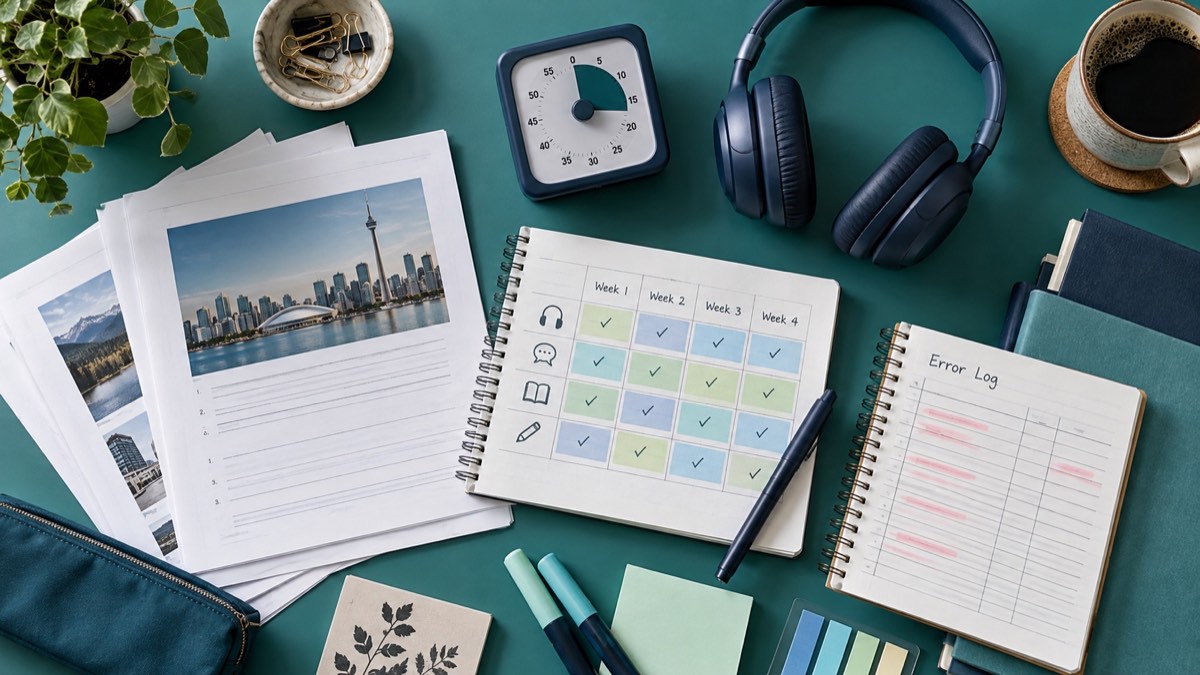
A useful CELPIP preparation routine begins with evidence, not a guess about how many hours you “should” study. Official samples can show you the task formats, timing and the kinds of responses the test expects. When you review them carefully, you can identify specific strengths and gaps, then build a weekly plan around the skills and tasks that need attention.
This guide explains how to use official CELPIP sample materials to create a practical preparation routine for Listening, Reading, Writing and Speaking. It covers diagnostic practice, error logs, targeted sessions and progress checks. It does not promise a score, prescribe one schedule for every candidate or replace the current test instructions. Check CELPIP’s live preparation pages before using any resource or timing detail.
Begin with the right CELPIP product
Before studying, confirm which test product you need. CELPIP-General assesses Listening, Reading, Writing and Speaking; CELPIP-General LS assesses Listening and Speaking. A practice routine for four skills is not the same as one for two. Verify the exact requirement with the organisation receiving your result before choosing materials or a test date.
The CELPIP test format and scoring page and official test overview explain the available products and test components. Requirements for a programme, authority or regulator should be confirmed with that organisation.
Write your goal in a form you can use: “I need CELPIP-General for this application, with these stated scores by this date.” If the application gives skill-specific thresholds, include them. Those thresholds help you prioritise your practice; they do not mean you should ignore other required sections.
Use official samples as a diagnostic, not a prediction
CELPIP provides free sample and practice resources through its preparation overview and free practice tests page. The provider describes sample practice as a way to become familiar with format and timing. Follow the current access conditions and instructions shown on those pages.
Choose a sample that covers the product and skills you need. Attempt it under conditions close to the official directions: use the intended timing, avoid interruptions and do not consult an answer key while working. A diagnostic only helps if it reflects what you can currently do without outside assistance.
A practice sample is not an official score. Some resources may provide answer keys for objective components, while productive tasks require a different kind of review. Treat the sample as a map of task demands and error patterns, not a guarantee of how you will perform on test day.
Do not use a single disappointing response to conclude that you are weak in an entire skill. Look for patterns across tasks. One missed reading question may be a vocabulary gap, a rushed scan or a misunderstanding of the question. The next practice session should test that cause.
Create a simple baseline record
After your first diagnostic, record a few details for each skill:
- Which task type felt unfamiliar?
- Where did you lose time or attention?
- Which answers were inaccurate, incomplete or unclear?
- Was the issue language knowledge, task strategy, timing or instructions?
- What evidence supports your diagnosis?
- What is one action you can practise next?
For objective questions, keep the question number, your answer, the correct answer if the official key provides one and the reason for the difference. For writing and speaking, save the response and assess it against the official guidance or descriptors available for that task. Avoid assigning yourself a band or level without a reliable basis.
Use neutral descriptions. “I missed two details after the speaker changed topic” is more actionable than “my listening is terrible.” “My email request was unclear” is more useful than “I can’t write.” A precise description points to the next drill.
Build a routine around your actual week
Choose a preparation schedule that fits your work, study and family commitments. Consistency matters more than building a timetable that looks impressive and is impossible to maintain. You might use four short sessions each week, one for each skill, or combine two related skills in a longer session. Adjust the plan to your deadline and energy.
A practical session has four parts: a clear target, a sample task, focused review and a next action. For example, a Listening session might target speaker purpose, include one task from an official sample, review where a key point was missed and end with a short note-taking drill.
Decide the session before you begin. “Practise Writing” is too broad. “Write one response using the task instructions, then check whether each paragraph supports the requested purpose” gives you a way to assess the work.
Leave space for review days. Completing new tasks without examining them can create a large practice history but little learning. Use one session to revisit errors, compare attempts and decide whether the strategy helped.
Listening: use samples to locate attention gaps
Begin by reviewing the current Listening task types and instructions. Attempt a sample without pausing the audio unless the official practice specifically allows replay. Afterward, use any official transcript or explanation supplied with the material to identify where your understanding changed.
Classify each error: missed a main point, confused a speaker’s position, overlooked a contrast, misheard a number, lost a detail after a topic shift, or selected an option because it sounded familiar. Different errors call for different practice.
If you miss contrasts, listen to short segments and note signal words such as “however,” “instead” or “although.” If you lose details after a new speaker begins, practise a simple speaker map with each person’s view. If numbers are difficult, separate the value from its unit and relationship to the question.
Do not write a transcript while listening. Use compact notes that preserve relationships. After the sample, compare your notes with the explanation and identify what you did not capture. CELPIP’s official study tips and resources include skill-specific guidance; verify the current page for available materials.
Reading: review why the answer fits
Official Reading samples can help you practise question navigation, identifying evidence and managing time. After you answer, return to the passage and locate the sentence or relationship that supports the correct choice. A correct guess is not the same as a dependable method.
For every missed item, classify the cause: unfamiliar word, reference word, inference, contrast, tone, detail location or rushed reading. Then write a short explanation of why the correct answer fits and why your chosen answer does not. Keep it grounded in the passage.
Try a two-pass routine. First, read the question and identify what information it requests. Then scan or read the relevant section, mark supporting words and compare the options. Avoid selecting an answer because it repeats words from the passage; the relationship may be wrong even when vocabulary matches.
If time is a recurring issue, record where time is spent. Are you rereading the entire passage for every question, or getting stuck on one unfamiliar phrase? Practise the specific navigation step rather than simply attempting more questions faster.
Writing: use official samples to revise purpose and clarity
For each Writing task, first identify who the response is for, what the prompt asks you to do and which details must be included. After drafting, compare your response with CELPIP’s current instructions and any official scoring descriptors or sample-response explanations available.
Review content before editing individual words. Did you address every part of the prompt? Is the purpose clear? Are the details relevant and organised? Then check paragraph sequence, sentence clarity, grammar, vocabulary and spelling. This order prevents you from polishing a sentence that does not answer the task.
Save a first attempt and a revised attempt. Mark only the changes that improve task response, organisation or clarity. If you use an official sample response, study how it handles the task; do not memorise its exact language or copy it into a future response.
Build a personal checklist from repeated feedback. It might include “state the requested action clearly,” “include the date and reason,” or “check verb tense in the final paragraph.” Keep the list short enough to use under timed conditions.
Speaking: review responses against task demands
Use official Speaking samples and response descriptors where available. Practise following the prompt, organising a clear answer and speaking at a pace that listeners can follow. Record yourself if your practice setup permits it, then review for relevance and structure before focusing on pronunciation details.
For each task, ask: Did I respond to the situation? Did I include the details the prompt needs? Is the main idea easy to follow? Did I use examples or reasons that support it? Did I finish naturally without rushing or stopping repeatedly?
Compare sample responses to understand the dimensions described by CELPIP, but do not imitate a speaker’s accent or assume one sample represents every acceptable answer. Use the official Speaking score descriptors if current and relevant to your product. Focus on intelligibility, task completion and development rather than trying to sound like someone else.
A sample four-week routine
The following is an example, not a mandatory schedule. Adapt it to your available time and the result deadline.
Week 1: Baseline and orientation. Review the current format, complete representative sample tasks and create an error log. Identify two or three priorities.
Week 2: Focused skill sessions. Practise one weak task at a time. Use official samples for format, then add short drills that address the diagnosed cause.
Week 3: Mixed practice. Combine task types and practise transitions between skills. Review whether strategies still work when the task changes.
Week 4: Progress check. Use fresh sample material under realistic conditions. Compare your errors with the baseline and decide whether your plan needs adjustment.
If you have more time, repeat the cycle with new material and updated priorities. If your deadline is close, focus on the highest-impact gaps and verify the result and reporting timeline with current official information. Do not assume that a set number of study weeks guarantees a particular outcome.
Use an error log that changes your next session
A useful error log includes the date, skill, task, what happened, likely cause and one next action. Keep the record brief. For example:
- Date: Monday.
- Skill/task: Listening, sample conversation.
- Error: I mixed up which speaker supported the proposal.
- Possible cause: I wrote topic words but not speaker labels.
- Next action: Use a three-column speaker map in the next practice.
Review the log every week. If the same cause appears repeatedly, make it a session target. If an error does not recur, move on rather than spending all your study time fixing one isolated problem.
Separate language gaps from strategy gaps. If you do not know a word, build vocabulary in context. If you know the word but choose the wrong option because you misread the question, practise question analysis. If a response is relevant but hard to follow, work on structure and signposting.
Make good use of official feedback
Read the instructions and any explanations that accompany official practice materials. For objective sections, understand why an answer is supported. For productive sections, compare your work with the task requirements and the official descriptors. Do not treat an example as the only acceptable response.
If a resource offers a score descriptor, use it to identify observable features. For speaking and writing, note what the response does: answers the prompt, organises ideas, develops relevant details and uses language clearly. Avoid unsupported labels such as “this sounds like a Level 9” when the sample or feedback does not establish that.
Keep older practice resources in context. If the task format has changed, confirm that a resource still matches the current test. The live CELPIP pages are a better source for current structure than a downloaded document with no date.
Common preparation mistakes
Practising without a goal. Select one skill or task feature before opening a sample.
Completing samples but never reviewing them. Use an error log to turn practice into a next action.
Assuming a sample result is an official score. Samples familiarise and diagnose; they do not guarantee a test outcome.
Studying only the weakest skill. Keep all required skills active while prioritising gaps.
Using outdated materials without checking format. Confirm current official instructions and dates.
Copying sample answers. Study their structure and task fit; create your own responses.
Doing too much practice at once. A sustainable weekly plan is easier to maintain and review.
Ignoring the application deadline. Plan backward from score receipt and reporting requirements.
Changing plans after every difficult question. Look for repeated patterns across multiple attempts.
A self-review card for official samples
After a practice task, ask:
- Did I follow the current instructions and timing?
- What did the task require me to do?
- What is one thing I handled well?
- What was the first meaningful error or omission?
- Was the cause language knowledge, task understanding, timing or attention?
- Which official explanation or descriptor helps me understand it?
- What specific action will I test next time?
A concise entry such as “Writing: I answered the request but omitted the delivery date; next attempt, underline every required detail before drafting” gives your next session a clear purpose.
Final guidance
Official CELPIP samples are most useful when you use them to learn the current format, identify a specific gap and choose a targeted next step. Start with a diagnostic, review each skill with the right task lens and keep a short error log. Return to fresh sample material after focused practice to see whether the change helped.
Build a realistic schedule around your requirements and available time. Confirm your test type and score conditions with the receiving organisation, and use current CELPIP pages for instructions and study resources. Preparation can be organised and evidence-based without promising a particular score. For a booking overview, visit the CELPIP guide, then check the current test provider information directly.
Use the sample to choose one different next action per skill
Consider a fictional diagnostic record. Listening: the candidate confuses which speaker supports a proposal, so the next exercise uses speaker-labelled notes. Reading: the candidate selects a choice that repeats a passage word but reverses the relationship, so the review must identify supporting evidence. Writing: the response omits a requested date, so the next attempt begins by marking required details. Speaking: the response gives a recommendation without a reason, so the next exercise develops one relevant reason.
Each observation leads to a different action. Completing another full sample without those actions may reproduce the same pattern. Use official explanations and descriptors for the actual resource rather than assigning one homemade numerical score to all four observations.
At the next fresh check, record what happened to the specific issue: the speaker's view stayed correctly attributed, the reading choice matched evidence, the writing date appeared, or the spoken reason became clear. Improvement on a practised item is useful rehearsal; a fresh appropriate task provides a stronger transfer check. Keep the original sample reference and the later response so you can explain the comparison accurately.
Official references
About this guidance
This article offers independent planning and practice guidance. Official references are linked in the text. References last checked: 2026-10-26. Provider requirements and receiving institutions’ policies take priority; check the current instructions before booking or acting.