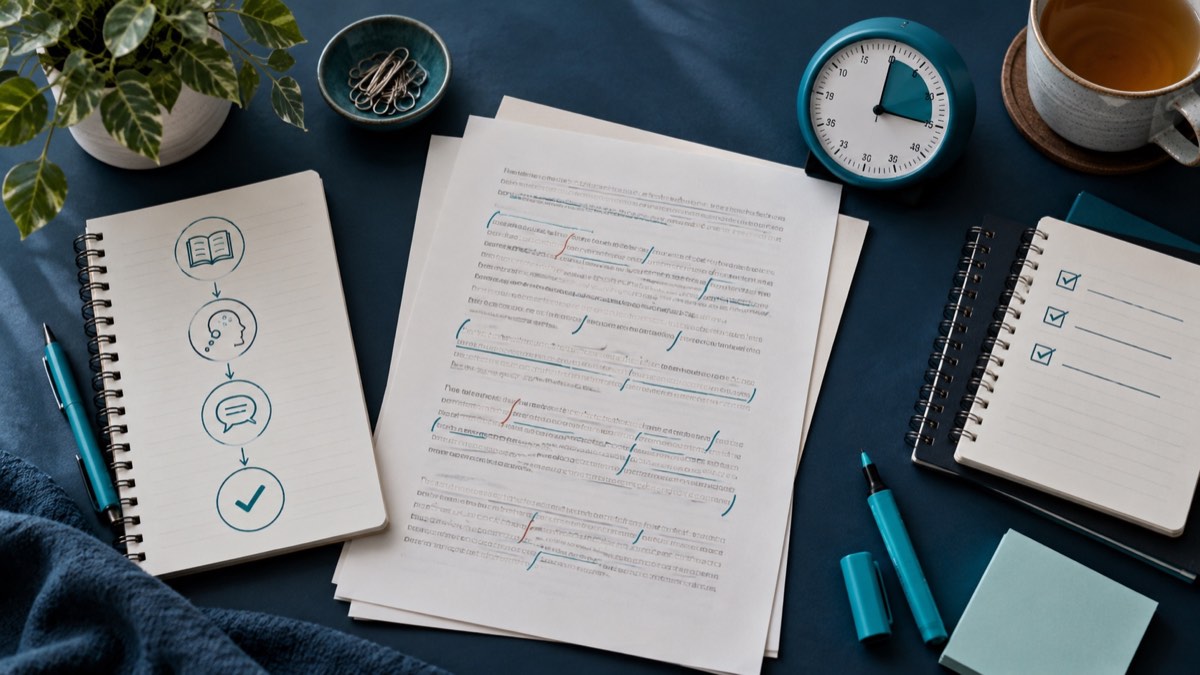
PTE Read Aloud combines silent preparation with speaking from a visible passage. You can see the words, but a strong attempt still depends on how you group the text, notice punctuation, handle unfamiliar terms and keep a natural pace while recording. Reading every word as a separate unit can sound choppy; rushing to finish can blur words and disrupt phrasing. A practical method helps you use preparation time to understand the sentence structure before the microphone opens.
This guide explains how to practise PTE Read Aloud using original passages, how to mark phrase boundaries, how to handle difficult vocabulary and how to review a recording without confusing pronunciation with comprehension. It does not predict a score or teach a scoring shortcut. Check Pearson’s current instructions for the test version you are taking because task details can change.
Know what the task asks you to do
In PTE Academic Read Aloud, text appears on screen and you read it aloud. Pearson’s current official format page describes a passage of up to 60 words and a preparation period that varies with passage length; the current guidance gives 30 to 40 seconds to read and prepare before the microphone opens. The exact test instructions shown to you are authoritative. Check the official PTE Academic Speaking and Writing task guide before relying on any timing detail.
The task appears within Speaking and Writing, but the response is spoken. Your preparation time is not an invitation to memorise the passage from beginning to end. It is a chance to scan the text, understand its structure, identify words that may need attention and decide where the natural phrase groups are.
The visible text gives you information that Repeat Sentence does not: you can look at the exact words. The challenge is to turn that text into clear speech under the recording conditions. Practising silently only is not enough. Practising aloud without using the preparation window is not enough either. Build both parts into your routine.
Read for meaning before you mark pauses
Start by understanding the main point of the passage. Ask yourself who or what it is about, what the main statement says and how the remaining clauses develop it. Meaning provides a map for phrasing. Without it, punctuation can become a mechanical set of stop signs.
For example, consider this original practice passage: “The city library has expanded its evening programme, allowing local residents to attend workshops after work.” The main statement is that the library expanded its programme. The second part explains what that change allows. A natural reading connects the two ideas without an unnecessary full stop between them.
Now consider: “Although the trial produced promising results, researchers recommend further testing before changing the policy.” The opening clause sets up a contrast. A brief pause after “results” helps make the relationship clear, but the sentence remains one connected thought. The word “although” matters: it signals that the positive finding does not end the discussion.
Do not invent a meaning that the passage does not support. If a sentence is technical, use the words around an unfamiliar term to understand its role. You do not need to become an expert on the topic during the preparation interval; you need a workable sense of its structure and the words you must pronounce.
Divide the passage into meaningful chunks
Phrase groups are short runs of words that belong together in speech. They often follow punctuation and grammatical structure: a subject with its verb, a prepositional phrase, a dependent clause or a list. Reading in groups helps you maintain natural rhythm and remember where the sentence is going.
Mark boundaries lightly during practice. A slash can show a small pause; a double slash can show a stronger boundary at a sentence end or a major clause break. Avoid marking every few words. Too many boundaries make delivery sound fragmented.
Original example:
“Researchers at the coastal institute / collected water samples throughout the spring / to study changes in local marine habitats.”
The first group identifies the people and place. The second describes their action and timing. The final group explains the purpose. You can read the entire passage as connected information, with a modest pause between the larger units.
Try not to impose a pause where the grammar strongly connects words. In “a series of measurements,” the head noun and its following phrase belong together. Pausing after “series” would separate words that form one unit. Likewise, do not pause between an auxiliary verb and the main verb just because you need to take a breath.
Use punctuation as a guide, not as a complete map. A comma often signals a boundary, but its spoken effect depends on the sentence. A colon may introduce a list or explanation; a semicolon may connect two related independent clauses. During practice, identify what the punctuation is doing before deciding how long to pause.
Use preparation time in a consistent sequence
A reliable preparation routine reduces last-second decisions. Adjust it to the time displayed in the actual task, but practise the same sequence:
- Scan the whole passage. Notice the number of sentences, topic and punctuation.
- Find the main clause. Identify the central subject and action or claim.
- Mark phrase groups. Use the grammar and punctuation to find natural units.
- Check difficult words. Notice unfamiliar names, long terms, endings and consonant clusters.
- Choose a steady pace. Aim to speak clearly through the entire text without racing.
Do not spend the whole preparation window rehearsing the first sentence. The later sentence may contain the longest phrase or the most challenging word. Give the complete passage one scan before you begin detailed preparation.
If you are uncertain about a word, make a pronunciation plan without turning the rest of the passage into a panic. Identify its syllables if you know them, notice the stress pattern from your vocabulary knowledge and continue preparing the surrounding phrase. Do not spend the full interval trying to perfect one difficult term.
At the microphone cue, begin promptly as instructed. Do not start early. Follow the current on-screen prompt and recording indicators. During practice, simulate the transition from preparation to speaking so that you do not rely on a pause or restart that will not be available in the same way during the test.
Practise phrase grouping with original examples
Use new passages rather than memorising a small set. The following original examples are for practice and are not Pearson test content.
Example 1: “Many public gardens offer quiet areas where visitors can read, relax or observe seasonal plants.”
Possible grouping: “Many public gardens / offer quiet areas / where visitors can read, relax or observe seasonal plants.” The relative clause explains the areas. The list shares one verb and can be read smoothly without a separate pause after every item.
Example 2: “The updated timetable will reduce waiting times, but passengers should check the departure board for platform changes.”
Possible grouping: “The updated timetable will reduce waiting times / but passengers should check the departure board / for platform changes.” The conjunction marks a contrast. The final phrase explains what the board may show.
Example 3: “When the laboratory equipment is calibrated correctly, the measurements become more consistent across repeated trials.”
Possible grouping: “When the laboratory equipment is calibrated correctly / the measurements become more consistent / across repeated trials.” The opening dependent clause sets a condition. The main statement follows it.
Example 4: “A local history project invited residents to contribute photographs, letters and recordings from family collections.”
Possible grouping: “A local history project / invited residents to contribute / photographs, letters and recordings / from family collections.” The final phrase identifies the source of the materials. Read the list with parallel rhythm.
For each practice passage, compare your own grouping with the grammar. There may be more than one natural way to phrase a sentence. The purpose is not to use the exact same slash positions as an answer key; it is to produce connected, intelligible speech without breaking important relationships.
Keep a steady pace instead of racing
A common mistake is to equate speed with fluency. A fast reading can still sound unclear if word endings disappear, stress becomes uneven or pauses occur in the wrong places. A slightly slower pace with complete phrases is often easier for a listener to follow.
Use a metronome only as an occasional awareness tool, not as a rigid target. Natural sentences vary in length and complexity. A steady pace means that you do not suddenly accelerate through unfamiliar vocabulary or slow down dramatically at every comma.
Practise with a timer, but set the goal as completion with clarity, not finishing as early as possible. If you regularly run out of time in practice, look at the cause. Are you pausing to decode words, restarting, or speaking too slowly because you are unsure of the phrase structure? The remedy differs for each problem.
Read a short passage once at your usual pace and record it. Then read a new passage while focusing on phrase groups. Compare whether the second attempt feels more connected. Do not repeatedly reread the same text until the words become automatic; use new material to see whether the skill transfers.
Handle unfamiliar and technical vocabulary
A passage may include a word you do not use often. The goal is to make a clear attempt while protecting the rest of the sentence. During preparation, identify the word, look at its spelling and syllable pattern, and consider its role in the sentence. You may recognise a prefix, suffix or familiar root that helps you pronounce it.
Do not invent a pronunciation from the spelling alone if the word is irregular and you know a standard pronunciation. Build vocabulary from reliable dictionaries and audio resources outside the timed task. Keep a personal list of challenging words drawn from practice passages, with the word, a pronunciation reference and a short example sentence.
For a long compound term, notice where the syllables divide and which syllable carries stronger stress. Practise it in the full phrase rather than repeating it in isolation forever. A word can sound different when connected to surrounding words, so phrase-level rehearsal matters.
If a word remains uncertain, avoid stopping before you have read the sentence. One difficult item should not derail the passage. Continue at a measured pace, make the clearest pronunciation you can and preserve the next phrase. During review, record the word and study it later rather than repeating the same passage until you remember it by sight.
Use punctuation without overacting it
Punctuation helps organise meaning, but it does not require theatrical pauses. A comma may call for a slight boundary, not a full stop. A period usually marks a stronger end, but your voice should remain natural. A question mark changes intonation, though not every question needs a dramatic rise.
Read this original example aloud: “The survey, which included residents from three districts, asked how often they used the public transport network.” The commas set off an explanatory clause. You can lightly distinguish that clause while keeping the main sentence intact. If you pause too strongly after “survey,” the listener may expect the thought to be complete.
Now consider: “The team tested the new material in the laboratory; the results were later compared with field observations.” The semicolon connects two related statements. A modest pause can show the boundary, but the relationship remains close.
During practice, mark only the boundaries that help a listener follow the syntax. If you are pausing after every punctuation mark for the same duration, vary the pause according to the relationship between the clauses.
Pronounce clearly without imitating an accent
Your goal is intelligibility. Focus on the sounds and stress patterns that affect whether a listener can recognise the words. You do not need to imitate a particular accent. Build clear vowels and consonants, preserve the endings of plural and past-tense words, and avoid dropping syllables when the pace increases.
Use a two-listen review. On the first listen to your recording, follow the text and note words that were omitted, substituted or misread. On the second listen, ignore the exact wording and focus on clarity: word endings, phrasing, stress and pace. Keeping the passes separate makes your notes more useful.
If you have difficulty distinguishing a sound, select a small number of examples and practise them in words and phrases. Avoid trying to change every feature of your speech at once. A focused goal such as “keep final consonants audible” is easier to assess than “sound perfect.”
Recordings can make your own voice seem unfamiliar. Do not use that discomfort as proof that your pronunciation is poor. Assess whether the words are intelligible and whether the phrase groups help the text make sense. If possible, ask a qualified teacher to identify one or two recurring issues using specific examples.
A diagnostic routine for reviewing practice
For every practice attempt, note the date, passage source, one main strength and one next action. Review the recording with these categories:
- Accuracy: Did I read the visible words in the correct order?
- Omission: Did I skip a word, ending or phrase?
- Substitution: Did I replace a word with another one?
- Phrasing: Did pauses preserve the grammatical groups?
- Pace: Did speed remain steady through familiar and unfamiliar phrases?
- Clarity: Could a listener understand the words without needing the text?
- Completion: Did I finish the passage according to the current task instructions?
Mark the first point where the reading changed. If you skipped a small word, identify whether you lost your place or misread it. If you changed a technical term, add it to your vocabulary list. If the delivery became rushed near the end, check whether you underestimated the remaining text during preparation.
Choose one focus for the next set. A review note could be: “I paused between the adjective and noun in three passages; next set, group noun phrases before speaking.” A vague note such as “improve speaking” does not tell you what to practise.
Worked example: from text to spoken plan
Original passage: “Community researchers interviewed shop owners during the autumn festival to understand how seasonal events affect local business.”
Scan: One sentence about an interview project and its purpose. There is a time phrase and an infinitive phrase at the end.
Main clause: “Community researchers interviewed shop owners.” This is the central action.
Additional information: “during the autumn festival” tells when. “to understand how seasonal events affect local business” explains why.
Possible phrase groups: “Community researchers / interviewed shop owners / during the autumn festival / to understand how seasonal events affect local business.”
Pronunciation check: Notice “researchers,” “interviewed,” “seasonal” and “business.” Practise any uncertain word silently or mentally without using all the time on it.
Delivery plan: Start clearly, link the main clause, make a small boundary before the purpose phrase and finish without an unnecessary pause before “local business.”
After recording, check whether the purpose phrase remained complete. If it did not, the next exercise might focus on holding longer final phrases. If the words were all correct but the pauses were choppy, practise joining grammatical units. The plan is diagnostic, not a guarantee of a score.
Develop a weekly Read Aloud practice routine
A short routine several times a week can be more useful than one exhausting session. Use fresh passages and rotate the focus so you develop accuracy, phrasing and delivery together.
Session A: punctuation and clause groups. Select a few new passages. Underline main clauses, circle connectors and mark phrase boundaries. Record one attempt for each. Review whether pauses matched the structure.
Session B: vocabulary and endings. Practise new passages that include some unfamiliar words. Note plural, tense and word endings. Build a short personal vocabulary list after the attempt and study those words separately.
Session C: timed mixed practice. Simulate the current preparation and recording sequence using a variety of passages. Do not stop or restart after a mistake. Review the first error and choose one priority for the next week.
Adjust the amount of practice to your overall preparation plan. Read Aloud is only one task type in PTE Academic. Use Pearson’s current format guide to understand the wider test and divide preparation time across your needs. If your deadline is near, prioritise repeated errors and current instructions rather than trying to complete an arbitrary number of passages.
Common practice mistakes
Reading word by word. This makes speech choppy and hides the sentence structure. Group related words before speaking.
Using the same practice passage repeatedly. Familiarity makes the reading easier without proving transfer. Use fresh passages for assessment.
Rushing to finish. Speed can reduce clarity and create skipped endings. Aim for a controlled natural pace.
Pausing at every comma. Some commas introduce short explanatory phrases; others separate list items. Let grammar and meaning determine the pause.
Spending the entire preparation interval on one word. Prepare the whole passage, then attend to difficult vocabulary in proportion to its importance.
Restarting after a stumble. A restart may consume time and disturb the remaining phrase. Continue as clearly as possible and review afterward.
Practising only in silence. Silent preparation does not train the transition to spoken delivery. Include timed recordings.
Judging accent instead of intelligibility. Focus on recognisable words, word endings, stress and connected phrasing.
Treating a practice performance as an official score forecast. Practice is a way to find needs, not a guarantee of a test result.
A preparation card you can reuse
Before each attempt, ask:
- What is the passage mainly about?
- Where are the main clause and supporting information?
- Which phrase boundaries will help a listener follow it?
- Which words or endings need attention?
- Can I maintain a steady pace through the final phrase?
After the attempt, record:
- The first word or phrase I omitted or changed.
- Whether pauses followed the sentence structure.
- Whether my pace stayed clear to the end.
- One vocabulary item to study later.
- One action for the next fresh passage.
Keep the card brief. You want a repeatable practice habit, not a long analysis that replaces speaking.
Connect preparation to your test plan
Choose a test date that gives you room to prepare and fits the deadline for your receiving institution. Confirm current PTE Academic availability, booking conditions and identification rules through Pearson. If comparing a voucher or assisted booking option, verify the exact test product, eligible country, complete price, expiry, delivery and support terms in writing before paying. A booking or voucher does not guarantee a score or an admissions outcome.
The PTE exam guide explains broader test planning, while the PTE exam booking page covers booking considerations. Check current official instructions before making a decision.
Final practice principle
PTE Read Aloud rewards preparation that connects meaning, phrasing and clear speech. Use the visible text to identify the main clause, group related words and plan a steady pace. Practise with original passages, review exact errors and use fresh material to check whether your method transfers.
After each attempt, ask what the listener would have heard and what changed in your reading. Improve one observable feature at a time, then return to the full task. This gives your preparation a clear direction while keeping Pearson’s current test instructions at the centre of your plan.
Official references
About this guidance
This article offers independent planning and practice guidance. Official references are linked in the text. References last checked: 2026-10-26. Provider requirements and receiving institutions’ policies take priority; check the current instructions before booking or acting.