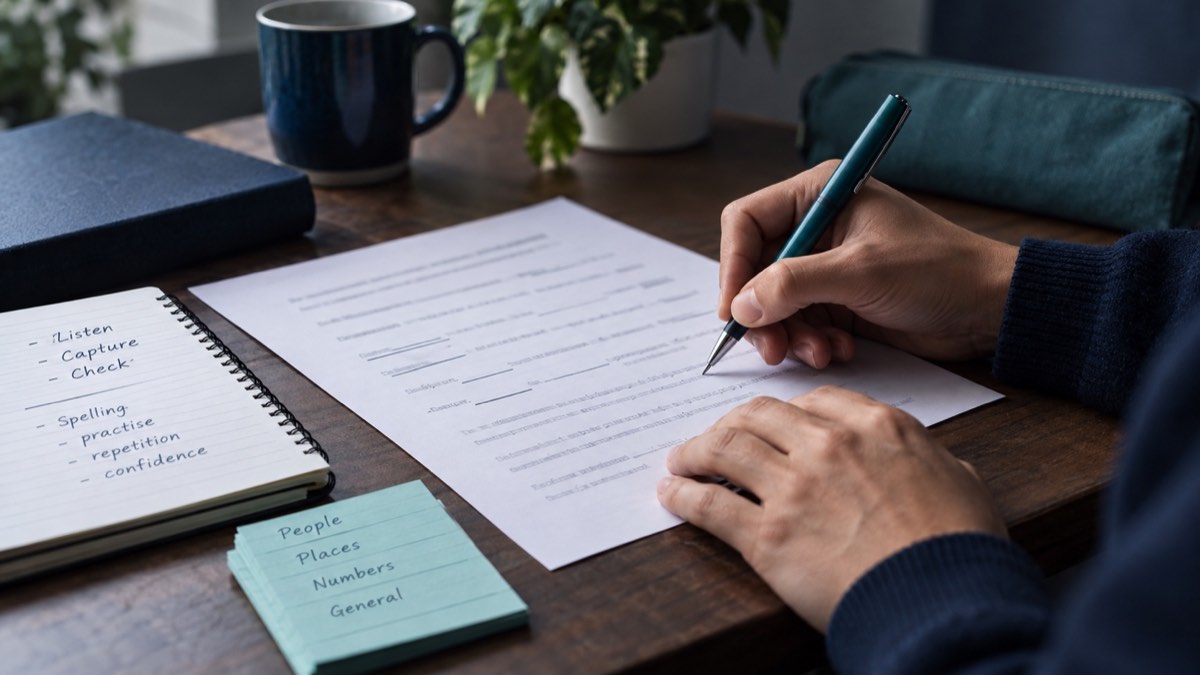
PTE Listening Fill in the Blanks asks you to listen to a recording while completing missing words in a transcript on screen. Because the audio plays once, success depends on using the brief preview to understand the topic, listening for the words that fit each gap, and checking spelling after the recording. Guessing from grammar alone can produce a plausible sentence with the wrong word; focusing only on individual blanks can make you lose the meaning of the recording.
This guide gives you a practical routine for PTE Listening Fill in the Blanks (Type In), with original practice passages, error categories and a way to build vocabulary from missed words. Pearson’s task format and instructions can change, so check the current official PTE Academic Listening page before your test. The examples here are original learning material, not official questions.
Understand what the task requires
In the current PTE Academic Listening task, you see a transcript with gaps and listen to an audio recording. You type the missing words into the transcript. Pearson’s official guidance says the audio plays once and allows candidates to take notes. The preview time is brief, so it is useful for scanning the topic and sentence structure rather than trying to solve every blank before listening.
The task combines listening with accurate written entry. You need to recognise the word in connected speech, retain enough of its sound to identify it, and type the correct spelling. A word can be clearly heard but entered incorrectly if you are uncertain about its spelling. Another may be spelled correctly in your notes but not match what was spoken.
The visible transcript is a support and a constraint. Surrounding words help you predict a grammatical category or topic, but they do not prove which answer the speaker used. A noun may fit the sentence grammatically while another noun carries the intended meaning. Listen for the actual word and use context to confirm it.
Use the preview to map the text
During the short preview, do not spend time guessing every missing word. First read the beginning and ending of the passage if visible. Identify its broad subject and the relationship between sentences. Look for repeated key terms, proper nouns, contrast markers, cause-and-effect phrases and examples.
Then scan the words immediately around each gap. Ask what kind of information may belong there: a person, place, action, adjective, time expression, connector or technical term. This prediction narrows attention, but keep it flexible. If you decide too early that a blank must be a particular word, you may mishear a different but contextually correct answer.
A simple preview note might look like this:
- Topic: a community transport project.
- Gap 1: likely an action or verb.
- Gap 2: perhaps a number or time phrase.
- Gap 3: a reason introduced by “because.”
These are listening targets, not final answers. Do not write a complete imagined sentence in place of the audio.
Listen for meaning and sound together
When the recording begins, follow the transcript from the start. Listening only for gaps can make you miss the sentence that explains the subject. Listening only to the overall idea can leave you unable to identify precise words. Move between the two: understand the passage, then focus on the next blank as its phrase approaches.
Pay attention to the sounds around a possible answer. Connected speech can link the end of one word to the beginning of another, and unstressed words may be less prominent. Notice the word’s syllables, stress and grammatical ending. If you hear a verb followed by a reduced ending, check whether the sentence context supports a past or present form; do not add an ending merely because the grammar seems to require it.
Where permitted by the current on-screen instructions, use brief notes to capture uncertain words during playback. Notes should be reminders, not a substitute transcript. For example, write a rough sound or first letters and move on. Spending too long on one blank risks missing later information.
Do not pause the recording, replay it or use a transcript source that violates the practice activity’s rules. In a real test, the official playback conditions apply. Train with one-listen exercises so your practice reflects the attention demand.
Separate listening errors from spelling errors
After a practice attempt, classify each incorrect response. This is more useful than simply counting wrong blanks.
Missed because attention was elsewhere. You were deciding about a previous gap and did not hear the next word. Practise moving on when uncertain and use short notes.
Heard the sound but could not identify the word. The word may be unfamiliar, reduced in speech or confused with a similar sound. Add it to a vocabulary list with a reliable pronunciation reference.
Identified the word but spelled it incorrectly. Study its spelling pattern and use it in a few original written sentences. Do not assume that a phonetic note is the final answer.
Chose a grammatically possible but incorrect word. The preview prediction may have been too rigid or context may have overridden the sound. Practise listening first and using grammar as a check afterward.
Added a word that was not spoken. You may have completed the sentence from expectation rather than evidence. Check whether every typed word matches the audio, including small function words and endings.
Lost the place in the transcript. Mark your position visually during practice, or use a consistent cursor movement strategy that follows the current interface instructions. Avoid jumping ahead based on a guess.
Record the error type, the target word, what you heard and a next action. A note such as “heard ‘statistical’ but entered ‘statistics’; review word form and suffix” identifies the issue more clearly than “listening was weak.”
Original practice exercise: community gardens
Try the gap version first. Ask someone to read the passage once at a natural pace while you follow the gaps. If you are practising alone, use a text-to-speech reader and look away from the script while it plays. This is an original practice exercise, not Pearson audio or an official test question.
Attempt:
“Several neighbourhoods have introduced shared gardens on unused land. Residents volunteer to prepare the soil, select suitable crops and maintain the plots throughout the ______ season. The project also gives local schools an opportunity to discuss food systems and environmental care. Organisers say that regular meetings help participants share skills and resolve practical ______.”
Reveal the reader script and answers after your attempt
“Several neighbourhoods have introduced shared gardens on unused land. Residents volunteer to prepare the soil, select suitable crops and maintain the plots throughout the growing season. The project also gives local schools an opportunity to discuss food systems and environmental care. Organisers say that regular meetings help participants share skills and resolve practical problems.”
Answers: “growing” and “problems.”
Review the process rather than only the answer. Did “growing” arrive as a clear word or did you infer it from “season”? Could “regular meetings” draw your attention away from the later blank? If you wrote “challenges,” that word may fit the meaning but it was not spoken. In a completion task, exact listening matters.
Original practice exercise: research methods
Try the gaps before revealing the reader script. Use a new passage or reader if you repeat the exercise; otherwise you may remember the text rather than practise listening.
Attempt:
“Before comparing the results, the research group checked whether each survey used the same ______. Differences in wording can influence how participants interpret a topic. The team recorded the sampling method and response rate so that readers could assess the strength of the ______. A clear report also explains which conclusions remain uncertain.”
Reveal the reader script and answers after your attempt
“Before comparing the results, the research group checked whether each survey used the same questions. Differences in wording can influence how participants interpret a topic. The team recorded the sampling method and response rate so that readers could assess the strength of the evidence. A clear report also explains which conclusions remain uncertain.”
Answers: “questions” and “evidence.”
The phrase “same” may lead you to expect a noun, but several nouns could fit. The recording gives the word. In the second gap, “strength of the” signals a noun phrase, yet “evidence” is identified by both sound and context.
Use a fresh reader or audio file for the second attempt if you want a true listening check. If you reread the complete answer before listening again, you may be recalling the text rather than recognising the audio.
Practise numbers, names and word forms
Some blanks may contain proper nouns, numbers or forms of a familiar word. These details are easy to lose because your attention may focus on the broader message. During the preview, capital letters and nearby titles can signal a name. Listen for how the name sounds and use surrounding context to check whether it makes sense.
Numbers require careful attention to units and relationships. A recording might state a date, percentage, quantity or range. Note the number briefly and confirm that the transcript context supports it. Do not change a spoken number into a different form unless the response format allows it and the current instructions specify that convention.
For word forms, distinguish a base word from its inflected form. “Develop,” “developed” and “development” are related but not interchangeable. Listen for the ending and check the grammar around the gap. A short suffix can change the answer and its role in the sentence.
Create a personal review set from errors: the correct word, its part of speech, the sound or spelling issue, and one original example sentence. Revisit the list after a few days. The goal is to notice patterns in your listening and spelling, not memorise a fixed collection of answers.
Improve spelling without losing the recording
Because playback continues, you may feel pressure to type each word immediately. If the interface and current instructions permit notes, a brief phonetic reminder can help you preserve the sound while you continue listening. After playback, use the visible context and your vocabulary knowledge to settle spelling.
Practise common spelling contrasts in words you actually encounter: singular and plural endings, past-tense endings, doubled consonants, vowel combinations and suffixes such as “-tion” or “-ment.” Use reliable dictionaries or pronunciation references for unfamiliar terms. Avoid learning a large list of isolated words without examples; the surrounding phrase often helps you recognise the word next time.
If the spelling remains uncertain, compare only plausible alternatives. Ask whether the word is a noun or verb, what ending the sentence needs and which spelling matches the sound you noted. Do not replace a word with a synonym because you are more confident spelling it. The task asks for the missing word from the recording.
Practice in both directions: hear a word and write it; then read a written word aloud and listen to the recording. The first helps recognition and spelling; the second can improve your awareness of syllables and stress. Keep the exercises short and use fresh vocabulary.
Build a listening routine for gaps
A weekly practice set can rotate through three types of focus:
Preview and prediction. Scan the text and identify likely word types without filling in exact answers. After the attempt, note whether the predictions helped or biased your listening.
One-listen attention. Use unfamiliar recordings with a single playback. Practise moving on after an uncertain blank and capturing a brief note if permitted.
Spelling and word forms. Review missed words after the attempt. Group them by spelling issue, grammatical form or pronunciation feature and practise them outside timed conditions.
Keep a record of the number of blanks attempted and the kinds of mistakes. Do not use a single practice set to estimate an official score. Track progress across several fresh passages and note whether your attention, spelling or word recognition changes.
A worked response strategy
Imagine the visible transcript is about a museum conservation project. The first blank follows “The team used a new ___ to monitor humidity.” Before listening, you mark “likely noun; equipment or method.” The recording says “sensor.” Write a quick reminder and continue.
The next blank is in “This approach reduced the risk of damage to delicate ___.” You hear “materials” but are still thinking about whether “sensor” needs a plural. Instead of losing the second word, note “mater…” and move on. After the recording, use the phrase and the sound to enter “materials.”
A third blank follows “The data are reviewed ___ by the conservation staff.” You hear an adverb but cannot identify it fully. Note the sound and continue to the sentence ending. After playback, compare the possible word with the written context and your phonetic note.
The important feature is the sequence: predict broadly, listen, capture, move on, then verify. You do not need to solve every blank at the instant you hear it. You do need to avoid allowing one uncertain answer to make you miss the next phrase.
Common mistakes and what to do instead
Filling blanks from context before listening. Context helps prediction but does not reveal the spoken word. Keep predictions tentative.
Reading only the gaps. The whole passage provides topic and relationships. Scan it before playback and follow it during listening.
Focusing on one missed answer. Let it go temporarily, capture a brief note if allowed and keep listening.
Writing a long phonetic transcript. Notes can consume attention. Use short reminders and complete them after playback.
Ignoring word endings. A root may be correct while tense, number or word form is wrong. Listen for suffixes and verify grammar.
Using synonyms. A word that preserves meaning may still not match the recording. Enter what was said.
Assuming every practice recording follows the same topic pattern. Use varied content and speakers so you practise flexible attention.
Repeatedly replaying before answering. This can make practice easier than the official one-play condition. Include single-play attempts.
Treating accuracy as a test score prediction. A practice set is useful for diagnosing skill needs, not guaranteeing a result.
A self-review card
After every practice passage, answer these questions:
- What was the passage about?
- Which blank did I miss first, and what caused it?
- Did I use the preview to understand the text or to guess exact answers?
- Did I lose later words while thinking about an earlier one?
- Were errors caused by recognition, spelling, grammar or typing?
- What word or listening pattern should I review?
- What one change will I make in the next fresh attempt?
A useful entry might be: “Missed the final noun while checking an earlier spelling. Next set: note the uncertain word and keep following the transcript.” That is concrete and actionable.
Final guidance
PTE Listening Fill in the Blanks improves when you combine a quick text preview, flexible listening, concise notes and careful spelling review. Use the context to focus attention, but let the recording determine the answer. Classify errors so you can distinguish hearing, memory, spelling and attention problems.
Practise with original or official materials under the one-listen conditions described by Pearson. Verify the current interface and task instructions before test day, then use your log to guide preparation. For broader planning, see the PTE exam guide and connect this task work to the rest of your preparation. The aim is to hear each passage as a connected message while still capturing the exact words required by the gaps.
Official reference
About this guidance
This article offers independent planning and practice guidance. Official references are linked in the text. References last checked: 2026-10-26. Provider requirements and receiving institutions’ policies take priority; check the current instructions before booking or acting.