An IELTS writing revision routine should help you identify what prevents a response from communicating its ideas clearly. Checking spelling is useful, but it cannot repair an answer that misses part of the task, presents an unsupported argument or connects sentences poorly. Effective revision moves from the purpose of the response to its organisation and then to the language used to express it.
This guide offers a practical self-review method for IELTS preparation, using original before-and-after examples. It is not an official marking exercise, and the examples are not assigned band scores. Use the current official task guidance and assessment information for the test you are taking, and seek reliable feedback when you cannot judge an issue yourself.
Choose the correct task guidance before reviewing
Confirm whether you are preparing for IELTS Academic or General Training and identify the writing task you are practising. Do not apply a routine designed for one type of response mechanically to another. The task's purpose and instructions determine what a successful response needs to do.
The official IELTS preparation pages provide sample materials and links to relevant guidance. Use them as a reference when setting up legitimate practice. A self-created exercise can develop language, but it should be labelled as an exercise rather than presented as an authentic exam prompt.
Our IELTS overview can help you organise the broader test choice. This article focuses on revision after a practice response has been written. It does not replace task-specific preparation or claim that one editing checklist covers every requirement in equal depth.
Keep the original prompt beside your response during review. Judging the writing without the prompt makes it easy to praise fluent sentences that do not answer the question you were actually asked.
First check what the response is trying to achieve
Write a one-sentence description of the task in your own words. Identify the information, position or communicative purpose required. Then compare the response with that description. If you cannot explain how the main sections serve the task, investigate that before correcting individual commas.
Look for omitted parts. A prompt may ask you to address more than one issue, and a response can develop one part well while neglecting another. Mark the missing function explicitly rather than adding a sentence at random simply to make the answer longer.
Also check for material that does not help answer the task. A memorised introduction about modern society may sound polished while contributing little to the specific response. Remove or rewrite it if it delays the actual point.
This first pass is about relevance and completeness. It does not require you to write the entire response again immediately. Identify the most important structural change, then decide which paragraphs or sentences need revision to make that change work.
Separate a clear position from a broad statement
In an argument-based practice response, a broad statement about a topic may not tell the reader what you think about the question. Check whether your position is clear and whether the rest of the response develops it consistently.
Consider this original opening: “Public transport is very important and many people use it in different places.” The sentence introduces a topic but gives little direction. If the exercise asks whether a city should prioritise bus services over extra parking, the opening has not yet addressed that decision.
A more focused practice revision could be: “The city should prioritise more reliable bus services because they can improve access for residents who do not drive.” This version states a position and a reason. It is not automatically a high-scoring answer; its value depends on the task and how the argument is developed afterwards.
The lesson is to test what each sentence contributes. A specific claim gives the paragraph something to explain, while a generic statement can leave the writer searching for direction in the next sentence.
Review paragraph development before polishing vocabulary
For each paragraph, identify its main point and the explanation or example supporting it. If a paragraph contains several unrelated points, consider separating or narrowing them. If it repeats the same claim in different words, it may need development rather than another synonym.
Take this original draft: “Reliable buses are good for workers. Workers need buses. Therefore buses should be reliable.” The paragraph is consistent but circular. It restates the claim without explaining the practical consequence.
A revision might explain that unpredictable services make arrival times difficult to plan, then use a clearly hypothetical commuter example to show the effect. The example should support the argument without pretending to be a verified statistic or personal experience.
After revising, ask what the reader now understands that was missing before. If the answer is only that the paragraph is longer, the revision may not have improved it. Useful development adds reasoning, relevant detail or a clarifying illustration.
Keep examples proportionate to the claim
An example should illuminate a point, not silently prove a much broader claim than it can support. When you create a hypothetical scenario during practice, make its role clear and avoid presenting invented numbers as research findings.
For instance, a fictional worker missing a shift because of unreliable transport can illustrate a possible consequence. It does not establish how many workers in a real city experience the problem or prove that one policy will solve it universally.
Check whether the wording moves too quickly from “could” to “will” or from one case to every case. Adjust the strength of the claim to match the reasoning you have actually supplied. Clear qualification can improve accuracy without making the argument indecisive.
If your response relies on an example you cannot explain, replace it with a simpler one. The purpose is to communicate a relevant relationship under the task conditions, not to impress the reader with a complicated scenario that introduces new confusion.
Make connections visible without adding a linker everywhere
Read the last sentence of one paragraph and the first sentence of the next. Can you explain how the ideas connect? A transition word cannot create a relationship that is absent from the content.
Consider: “The buses are often late. Furthermore, the museum has a new exhibition.” The word “furthermore” does not make the second statement relevant to the first. If the response concerns transport policy, the writer needs a meaningful connection or a different point, not a stronger transition phrase.
Within a paragraph, check reference words such as “this” and “they.” The reader should be able to identify what they refer to. Repeating a key noun occasionally may be clearer than using a pronoun with several possible targets.
Do not turn revision into a search for the maximum number of connecting expressions. Look for a logical sequence first, then use the language needed to make that sequence easy to follow. Natural cohesion comes from connected ideas as well as explicit markers.
Repair sentences that carry too many jobs
A long sentence can be accurate, but length alone does not make writing sophisticated. If a sentence contains several claims, examples and qualifications, inspect whether the relationships remain clear. Splitting it may reveal the logic more effectively.
Here is an original overloaded draft: “The service is useful because people travel every day and the roads are busy which is a problem for workers who need to arrive on time and this should be improved by the council.” Several ideas are present, but the references and priorities are blurred.
A clearer practice revision could be: “Many workers rely on the service for their daily journey. When road congestion makes buses unreliable, those workers may struggle to arrive on time. The council should therefore investigate ways to improve reliability.” This version clarifies the sequence without claiming that sentence splitting is always the best answer.
Use the revision to diagnose the underlying issue. Perhaps the original lacked clear subjects, used “which” ambiguously or joined too many ideas. Practise that specific problem in fresh sentences so the improvement transfers beyond one corrected paragraph.
Check grammar patterns that recur in your own work
After the meaning and organisation passes, look for recurring language errors. You may notice subject–verb agreement, article use, tense consistency or sentence boundaries. Choose the patterns that actually appear in your responses rather than working through an unrelated grammar list every time.
For each pattern, keep one original incorrect sentence, a corrected version and a short explanation. If you cannot explain the correction, verify it through a reliable reference or feedback. Copying a correction without understanding it can leave the same problem unchanged in the next response.
Avoid correcting every unfamiliar-looking structure automatically. Some sentences are unusual but valid; others are familiar but inaccurate. When uncertain, focus on whether the structure expresses the intended meaning and seek evidence rather than relying entirely on instinct.
A useful practice cycle is to revise the sentence, write two fresh examples of the same structure and check those examples later. That turns feedback into a learning task instead of leaving it as a mark on an old document.
Revise vocabulary for precision
Ask whether a word expresses the meaning you intend in that sentence. Do not replace a clear common word with a longer alternative merely because the alternative looks advanced. Near-synonyms can differ in grammar, tone and meaning.
For example, “economic” and “economical” may be confused because they look related. A sentence about national policy and a sentence about a low-cost practical choice may require different wording. Verify the relevant usage rather than swapping words mechanically.
Check word combinations as well as individual definitions. A verb may require a particular preposition or object structure. Record a useful phrase in context when it causes a real error, then practise it in an original sentence.
During timed practice, use language you can control accurately. During untimed learning, investigate alternatives and expand your range carefully. These are complementary activities, but an experiment with unfamiliar vocabulary should not be mistaken for dependable performance under test conditions.
Use a staged review instead of rereading aimlessly
Give each reread a specific purpose. The first examines whether the response answers the task. The second examines paragraph logic and development. The third examines sentence clarity and recurring language errors. A final check can catch surface mistakes that remain.
This sequence prevents small corrections from consuming all your attention while a major relevance issue remains. It also helps you explain what changed between drafts. If every reread asks only whether the answer “sounds good,” the feedback may stay vague.
For practice, use different marks for different issues if that helps: a note for missing content, another for unclear logic and another for language. Keep the system simple. The annotation should direct a revision, not become a separate design project.
You do not need to make every possible improvement in one sitting. Prioritise the changes that most affect the reader's understanding and the task response. Then identify one or two lessons to apply before writing the next practice answer.
Compare the original and revised response honestly
Save both versions and describe the main improvements in plain language. For example: “The position is now explicit,” “The second paragraph explains its claim,” or “The reference of ‘this’ is clear.” These observations are more useful than assigning yourself an unsupported band increase.
Check whether the revision introduced a new problem. Adding an example may create repetition; changing a sentence may alter the meaning; replacing a word may require a different grammatical structure. Improvement should be assessed in the full response, not only in the edited phrase.
Remember that an extensively revised untimed answer does not demonstrate the same performance as a first timed attempt. Both have value, but they provide different evidence. Use the revised answer to learn and a later fresh task to check whether the lesson transfers.
If you seek feedback, send the prompt and explain which version the reviewer is seeing. Ask about a specific uncertainty rather than expecting a general score estimate to reveal every next step.
Plan a realistic revision week
A hypothetical study week might include one initial response, a separate review session, focused work on the main problem and a fresh response later in the week. The exact schedule should fit your available time and preparation needs.
Suppose the review reveals that paragraphs repeat claims without explaining them. The targeted session can practise developing one claim with a reason and a relevant example. The next full response then tests whether that development appears without extensive prompting.
If the main problem is instead sentence accuracy, choose a narrower language exercise. Do not repeat the same weekly routine regardless of what your writing shows. Revision is useful because it changes the next practice decision.
The exam resources hub can help keep official references and planning guides together. Select a manageable set of resources and use them consistently enough to understand what feedback each one provides.
Connect revision to the wider preparation plan
Use several fresh responses and appropriate feedback when considering readiness, rather than relying on one polished answer. A revision routine can improve the quality of practice, but it cannot guarantee an IELTS result or determine whether a receiving organisation's condition will be met.
If you are still choosing a test, the English test comparison guide helps structure acceptance and practical questions. Confirm the required IELTS product and conditions before allowing preparation convenience to determine the booking.
Review the purchase checklist before paying for any offer or assistance. A writing lesson, a preparation package and an exam booking are different products, and their terms should be clear.
For your next response, begin the review with one question: does this writing do what the task asks? Then examine how the ideas develop and how accurately the language expresses them. That order makes revision a purposeful part of learning rather than a final search for spelling mistakes.
A complete paragraph revision you can inspect
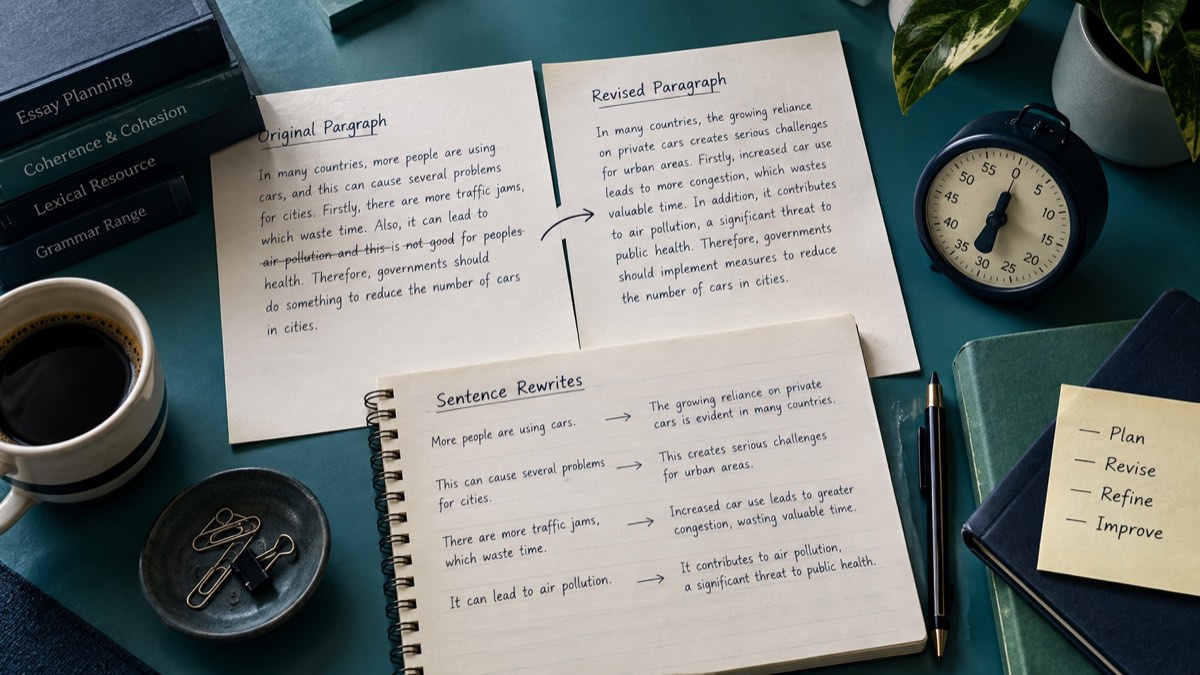
Use this original fictional practice claim: a city should improve bus reliability before adding more parking. First draft: “Buses are important for workers and workers use them. They are good and the government should make them better because this helps people.” The wording repeats the topic but leaves “better” and “helps” unexplained.
A more developed practice revision is: “The city should improve bus reliability because unpredictable journeys make it difficult for workers to plan their arrival. For example, a commuter whose usual bus is cancelled may have no affordable alternative for an early shift. Publishing a dependable timetable and addressing repeated cancellations could make that journey more predictable.” This is an invented exercise, not an official prompt, statistic or band-scored answer.
Compare the two by function. The revision states a position, explains a consequence, gives a relevant example and identifies a specific improvement. The claim is qualified with “could” rather than presenting one example as proof that every worker would benefit. Check whether each sentence answers the actual prompt before borrowing any approach from it.
Now transfer the method to a fresh topic: choose one claim, name the consequence and add a simple relevant illustration. Do not memorise the bus paragraph. The aim is to develop your own reasoning in a new response, then review sentence accuracy after the meaning is clear.
Official references
Official IELTS preparation resources and sample materials
About this guidance
This article offers independent planning and practice guidance. Official references are linked in the text. References last checked: 2026-10-26. Provider requirements and receiving institutions’ policies take priority; check the current instructions before booking or acting.