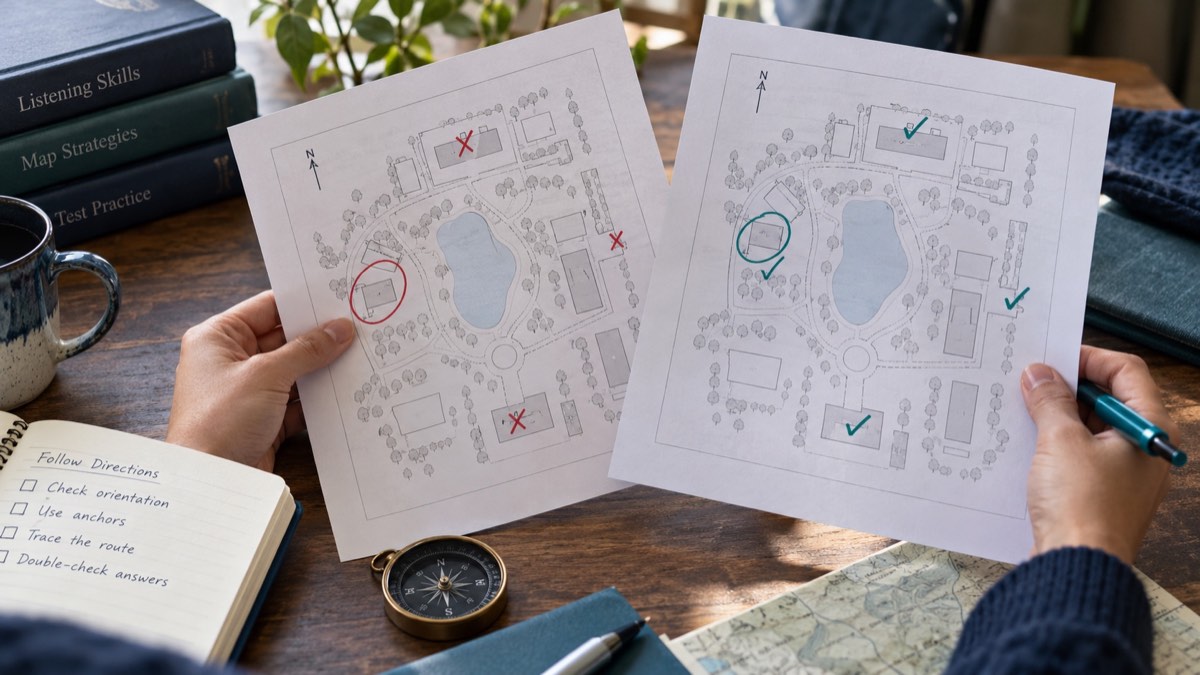
IELTS Listening plan, map and diagram labelling asks you to connect spoken information to a visual. The recording may describe places on a plan, parts of a diagram or locations on a map. You need to understand where the speaker is, follow directions and distinguish similar landmarks while the audio continues. Knowing compass words helps, but success also depends on previewing the visual and tracking how each location relates to the starting point.
This guide explains a practical method for IELTS Listening map and plan labelling with original direction exercises, anchor-point strategies and a review routine. The examples are written for practice and are not official test questions. Check the current IELTS Listening format and official sample tasks before your test for current question instructions and delivery details.
Understand what the task asks
IELTS Listening may include a plan, map or diagram with labels to complete. The official format describes the task as understanding a description of a place or diagram and relating spoken information to the visual. A speaker may give directions, describe positions or explain where an item is located. The precise response method depends on the question: you may choose from a list or enter a label.
Read the instruction carefully. Check how many answers are required, whether there is a word limit and whether options may be used more than once. The map itself is only part of the task; the instruction determines how you should respond.
The audio is played once in the test. Use official practice conditions that reflect the current format. Do not rely on a replay habit if the actual task will not allow replay.
Preview the visual before listening
Use the preparation time to understand the layout. Identify the title, entrance, main roads, compass arrow, buildings, rivers, paths or other fixed landmarks. Look at the answer labels and determine whether you are selecting from options or writing a name.
Choose a starting anchor. It might be the entrance, a road junction, a reception desk or a central building. Notice which features are north, south, east or west if the map includes a compass. If no compass appears, use the positions shown on the page: top, bottom, left and right.
Do not try to memorise every label. Identify the landmarks most likely to appear in directions and the route through the map. A short mental plan such as “start at gate, follow main path north, central building, then east wing” can orient you.
Follow the speaker’s route
Track directions from the stated starting point. Listen for movement verbs and spatial relationships: go straight, turn left, pass, cross, opposite, beside, behind, at the end of, through or beyond. Keep track of the speaker’s position after each instruction.
A common mistake is to treat every direction as if it starts from the entrance. Directions usually continue from the most recently described point unless the speaker signals a new starting place. Mentally move along the route as it is described.
Listen for corrections and changes. A speaker may begin to describe one location, then clarify that it is actually across the path or behind another building. Pay attention to contrast words such as “not,” “instead,” “rather than” and “but.” The final corrected information is often the relevant one.
Original practice map: community centre
Imagine a simple plan with an entrance at the south, a reception desk just inside, a café to the left (west), a large hall to the north, a garden east of the hall and a small meeting room west of the hall. A marked path connects the entrance, reception and hall.
Listen to this original direction description once:
“After you enter the centre, walk past reception and continue along the main corridor. The café is on your left before you reach the large hall. The garden is outside the hall on the right, through the glass doors. The small meeting room is not beside reception; it is along the short corridor on the west side of the hall.”
From the entrance, a listener should track: reception → corridor → café to the left → hall → garden to the right through doors; meeting room along the hall’s west side. The sentence “not beside reception” corrects a plausible but incorrect assumption. The description also gives two different reference points: the garden is located relative to the hall, and the meeting room is on the hall’s west side.
In practice, use a blank sketch or the official visual. Do not invent a new layout after the audio begins. The exercise is about relating speech to the given plan.
Original practice diagram: laboratory equipment
Imagine a diagram of a simple water-filter system. Water enters a container on the left, passes through a filter in the middle and collects in a clear vessel on the right. A small valve sits below the filter and a measurement dial is above it.
A description might say: “The incoming water first enters the left-hand container. It then moves through the central filter. The control valve is positioned underneath the filter, while the measurement dial is mounted above it. The cleaned water is collected in the vessel at the far right.”
The key relationships are sequence and position: left container → filter → right vessel, with the valve below and dial above the filter. “It” in the second sentence refers to water, while “it” in the third sentence refers to the filter. Grammar and topic continuity help resolve the references.
This type of exercise shows that the skill applies beyond street maps. A diagram can require understanding of parts, direction of flow and relative position.
Understand left and right from the speaker’s perspective
Left and right can be confusing when the visual has no obvious orientation. Check whether the speaker is describing a route from a person’s viewpoint or naming positions on a fixed map. Use the map’s compass and labelled features to orient yourself. If the task wording specifies a viewpoint, follow it.
In practice, draw a small arrow for the direction of travel. If you are moving north, left is west and right is east. If the route turns, the speaker’s left and right may change with the direction of movement. Do not assume that “on the left” always means the left side of the page.
Listen for phrases such as “facing the entrance,” “as you walk toward the river,” or “with the library behind you.” These establish orientation. Once the viewpoint is clear, keep it consistent until a new direction is given.
Use landmarks and route segments as anchors
A route becomes easier to follow when divided into segments. Identify the first landmark, the movement between landmarks and the next location. For example: “from reception, past the lift, turn right at the stairs, room at the end.” This is more reliable than remembering isolated words such as “lift,” “stairs” and “room.”
A landmark can be a road junction, statue, bridge, building or sign. Listen for whether the speaker says to pass it, turn at it, cross it or stop before it. These verbs describe different actions. “Beyond the bridge” is not the same as “before the bridge.”
If multiple places share a category, use modifiers. “The second entrance,” “the smaller building,” or “the path behind the café” distinguishes locations that would otherwise sound alike.
Practise direction vocabulary in context
Make a short personal vocabulary set from phrases you missed. Include opposites and examples:
- opposite / beside
- before / beyond
- across / through
- at the corner / around the corner
- on the left / to the left of the building
- at the end of the path / beyond the end of the path
- upstairs / on the upper floor
Practise each phrase with a simple sketch. Have someone describe a route and move a marker as you listen. Then explain the route back in your own words. This turns vocabulary into a spatial relationship rather than a translation list.
Be careful with phrases that depend on the starting point. “To the left of the entrance” describes a fixed location relative to the entrance; “turn left” describes a movement from the current direction. They are not interchangeable.
Handle corrections and distractors
In natural speech, a speaker may mention an option and then reject it: “The workshop is not in the building near the car park; it is in the smaller room beside reception.” Do not select the first location merely because it appears clearly in the recording. Listen for negation and correction.
A speaker can also mention a landmark as background information without making it the answer. Ask what the question requires: the building, room, route or position? The fact that a location is named does not mean it is the correct label.
After the recording, review the map against your route. If a response seems inconsistent, check whether you lost the starting point or missed a correction. Do not change an answer solely because another option was mentioned later; determine the relationship.
A method for answering under timed conditions
Use this sequence:
- Read the instructions and answer requirements.
- Scan the visual and identify the starting anchor.
- Note major routes, landmarks and orientation.
- Follow the audio in route segments.
- Mark each answer only after locating it relative to the anchor.
- Use remaining time to verify the route and check labels.
The exact order of actions may vary with the platform. Follow the current official instructions for the test mode you selected. During practice, do not pause to write lengthy notes if the visual itself gives you the needed structure.
If you miss one turn, try to reconnect at the next landmark rather than abandoning the rest of the map. The following direction may identify a fixed building or compass position that helps you recover.
Review mistakes by cause
After an official sample or practice set, classify each error:
- Orientation error: left/right or compass direction was misread.
- Starting-point error: directions were treated as if they restarted at the entrance.
- Sequence error: a turn, crossing or landmark was placed in the wrong order.
- Negation error: a rejected option was selected.
- Reference error: “it,” “there” or “the other building” was misunderstood.
- Instruction error: the wrong number or type of answer was given.
- Attention error: the map route was not followed while listening.
Write one next action for each recurring cause. If you confuse left and right after turning, practise changing orientation with a drawn route. If you miss corrections, listen to short examples containing “not,” “instead” and “rather than.” If you lose sequence, use route segments and anchor landmarks.
Build a practice routine
Use official IELTS sample materials for the current format. The official sample page includes plan or map labelling practice with answer keys and transcripts. First complete an attempt under the intended conditions. Then use the transcript to locate the exact phrase that established each answer.
In one session, practise map orientation without audio. In another, listen to route descriptions and sketch the path. In a third, complete a full sample and review errors by type. Use new maps and diagrams so the task is not reduced to memorising one route.
Keep a small log of the map type, starting anchor, missed direction phrase and next action. Review it weekly. Do not measure progress only by the number correct; understanding why a route was missed gives you a concrete way to improve.
Common mistakes and better responses
Looking at the map only after hearing the first direction. Preview the layout and anchor before playback.
Treating left and right as fixed page directions. Check viewpoint and direction of travel.
Restarting every route from the entrance. Track the current position from one landmark to the next.
Selecting a place mentioned in a correction. Listen for negation and the final location.
Focusing on every building name. Prioritise the route and the labels the questions request.
Writing long notes. Use the visual and brief anchors to preserve spatial relationships.
Ignoring the task instruction. Check how many answers to provide and whether options can repeat.
Practising a single familiar map. Use fresh official examples and varied diagrams.
Treating one practice set as a band estimate. Use it to diagnose direction-following skills, not promise a result.
A self-review card
After each map task, ask:
- What was my starting anchor?
- Did I keep track of the speaker’s current position?
- Which direction or landmark phrase caused difficulty?
- Did I hear a correction or negation?
- Was the answer wrong because of orientation, sequence, vocabulary or instructions?
- What one route drill should I use next?
A useful note could say: “I treated left as the left side of the page after the route turned; next time draw the direction arrow before applying left/right.”
Final guidance
IELTS Listening map and plan labelling combines visual scanning with careful listening. Preview the layout, choose a starting anchor, follow the route in segments and notice corrections. Use spatial language and landmarks together, then review the transcript to identify exactly where your route diverged.
Practise with current official samples and fresh original exercises. Check the instructions for your test mode, keep an error log and target the cause of repeated mistakes. A consistent route-following method supports preparation without relying on guesses or score promises. For the broader test overview, see the IELTS guide.
Official references
About this guidance
This article offers independent planning and practice guidance. Official references are linked in the text. References last checked: 2026-10-26. Provider requirements and receiving institutions’ policies take priority; check the current instructions before booking or acting.