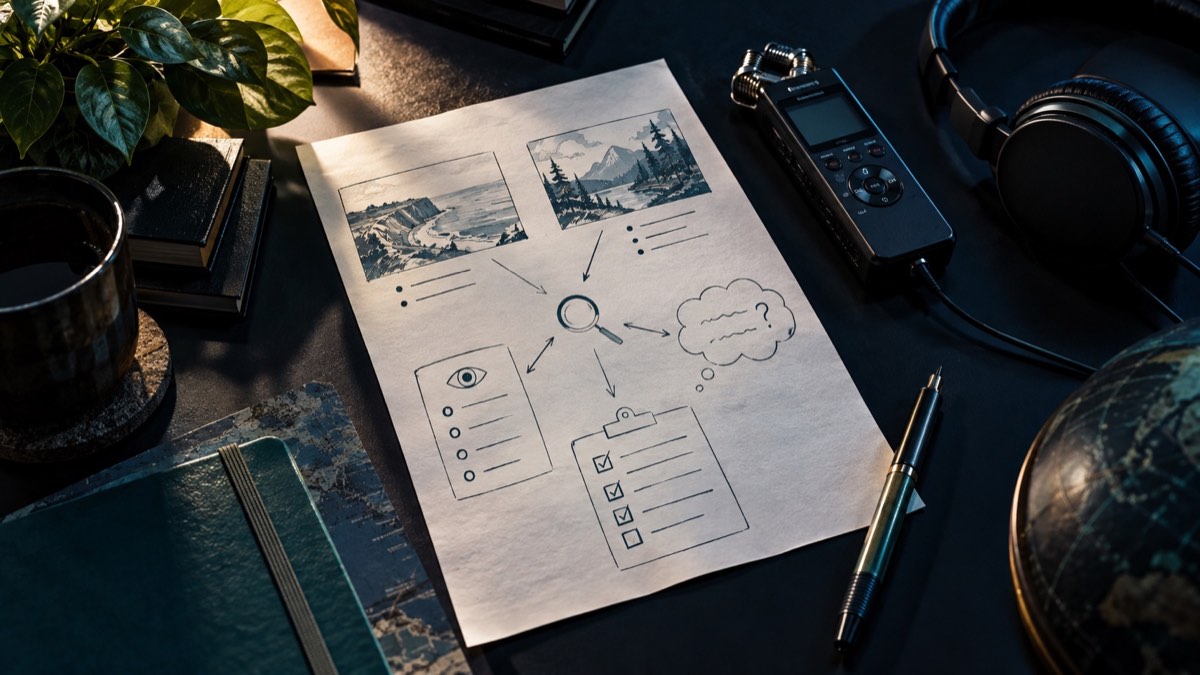
Duolingo English Test Speak About the Photo asks you to describe an image aloud. The task gives you a short time to observe the picture before recording begins, and you can continue looking at it while you speak. A clear response helps a listener who cannot see the image understand its main subject, action, setting and relevant details. Listing every visible object is rarely as useful as explaining how the main elements fit together.
This guide offers a practical method for DET Speak About the Photo, with original scene descriptions, a visual scanning routine, language for uncertainty and a focused review plan. The scenarios are described in words rather than reproducing test images; they are original practice concepts, not official items. Check the current official Speak About the Photo guidance before your test because task instructions may change.
Understand the task conditions
The official DET help article says the image and directions appear for 20 seconds before the recording screen. You may also look at the image while speaking. The task lasts up to 1 minute and 30 seconds, and you have one opportunity to record your answer. Check the current page and the instructions shown in your test account for the exact conditions.
The provider recommends imagining that you are explaining the image to someone who cannot see it. That is a helpful test for relevance: if your words do not allow a listener to form a basic picture of the scene, you may be listing disconnected details rather than describing it.
You do not need to invent a full story about what happened before or after the image. Describe what is visible and make cautious inferences when reasonable. If the image is ambiguous, use language such as “appears to,” “may be” or “could be” rather than asserting details the image does not show.
Scan the image in a consistent order
Use the observation time to build a quick scene map. You can scan from foreground to background, or divide the image into left, centre and right. Choose one approach and practise it until it feels natural.
Notice these elements:
- Main subject: Who or what draws attention first?
- Action or state: What is the subject doing, or what is happening?
- Setting: Where does the scene appear to take place?
- Relationships: How are the people or objects positioned or interacting?
- Useful detail: Which one or two details help explain the main scene?
- Uncertainty: What can you not confidently identify?
Avoid trying to name everything. If a scene shows a person in a workshop, tools on a bench and a window in the background, the person’s action and the workshop setting may matter more than the colour of every tool.
Build a simple spoken structure
A flexible description can move from the overview to details and then to a careful interpretation:
Overview: State the main scene in one sentence.
Details: Describe the action, setting and a few relevant objects or relationships.
Interpretation or contrast: Explain what the visible details suggest, while distinguishing observation from inference.
For example, an original practice concept might show two volunteers arranging boxes at a community event. A response could begin: “The image shows two people preparing supplies in a large indoor space.” It could then describe one person placing items in boxes while another checks a list, and note that the organised layout suggests they may be preparing for distribution. The word “may” signals that the purpose is inferred rather than directly visible.
The structure is a support, not a script. A quiet landscape may not have people or an action. In that case, describe the setting, visible features and relationships such as the path leading toward a group of trees.
Use the 20-second observation period well
Do not write a full speech in your head. Choose a main idea and a few supporting details. Plan mentally during the observation period and follow the current test instructions. The current DET page says you have 20 seconds to observe and mentally plan; follow the interface directions.
A concise plan might be: “busy market; vendor serving customer; produce on tables; people moving behind; lively public setting.” This gives you enough material to begin with a clear overview and develop the scene.
Look for an action before focusing on minor objects. Ask: what is happening? Then identify the people or objects involved, the location and one detail that helps explain the activity. If you cannot tell what an object is, describe its visible shape or function rather than guessing an exact name.
Original practice scene: a public market
Imagine a photograph showing a small outdoor market. A vendor stands behind a table of fruit, a customer points toward a basket, and a person walks past carrying a reusable bag. Several signs are visible but too distant to read.
Possible plan:
- Main scene: outdoor market with a vendor and customer.
- Action: customer choosing produce; vendor attending to the table.
- Details: baskets of fruit, another shopper, reusable bag.
- Setting: open-air public space.
- Uncertainty: sign text and exact fruit varieties are not clear.
A connected description could explain the scene without pretending to read the signs or identify every fruit. It might mention that the customer appears to be selecting an item and that the market seems active because other shoppers are nearby. “Appears” and “seems” keep the inference measured.
During review, ask whether the response let a listener picture the main activity. Did it spend too long describing the signs, even though they could not be read? Did it use a clear main idea before listing details?
Original practice scene: a study group
Imagine an image of three students around a table in a bright room. One points at a laptop screen, another writes in a notebook and a third looks at a printed page. A wall clock is visible in the distance.
Possible plan:
- Main scene: students working together around a table.
- Action: discussing material on a laptop and taking notes.
- Details: printed page, notebooks, bright study room.
- Relationship: shared task; different people contributing.
- Caution: do not assume the subject or assignment topic.
A weak description might say, “They are studying biology for an exam and are stressed because it is late.” The image does not establish the subject, deadline or emotion. A more accurate description focuses on visible evidence: “The students appear to be reviewing information together. One is pointing at the laptop while the others look at notes and a page.”
This example demonstrates how to distinguish observation from unsupported narrative. The purpose of the task is to describe the image, not invent a backstory.
Use precise vocabulary without overclaiming
Choose words that describe visible actions and relationships. Verbs such as arranging, carrying, pointing, examining, waiting, comparing and discussing can make a description specific. Spatial terms such as beside, behind, in front of, near and across help orient the listener.
If a detail is unclear, choose a broader accurate label. Say “a small container” rather than naming a specific tool you cannot identify. Say “a person in a uniform” if the job is not clear. This is better than confidently naming an object or role that the image does not support.
Avoid evaluative claims that cannot be seen. “The room is beautiful” may be a personal impression, but a description is more informative if it states that the room has large windows, several plants and natural light. If you want to include an impression, connect it to visible features: “The space looks calm because there are few people and the seating is spread out.”
Keep the response coherent and natural
Group related details together. Describe the main subject and action first, then add setting and supporting elements. Use connectors only when they clarify a relationship: “while,” “beside,” “in the background,” or “as a result.” Avoid repeating “there is” at the start of every sentence.
Speak at a natural pace and articulate clearly. Do not rush to mention every visible object. If you stumble on a word, recover and continue; the official DET guidance specifically advises staying calm and moving on. A small pause is preferable to an extended restart that interrupts the description.
You can vary sentence openings: “The image shows…,” “In the foreground…,” “Behind them…,” “A person appears to be…,” “The overall scene suggests….” Use these phrases when they help, not as a memorised sequence in every response.
Describe scenes with no obvious action
Not every photograph shows people doing something. A landscape, building, object display or street scene may have no single event to narrate. In that case, organise the description around location, visible features and spatial relationships. For a landscape, you might describe the foreground, middle distance and background. For an object arrangement, identify the main object, its position and nearby items.
Avoid inventing movement in a still image. If a person is standing beside a bicycle, you can say the person is beside it; you cannot know from the photograph alone whether they have just arrived or are about to leave. A cautious phrase such as “the person may be preparing to ride” makes the uncertainty visible, but it is often better to focus on what can be observed.
If the image contains several equally prominent elements, choose a broad overview and then describe one relationship. You do not need to decide which subject is most important if the composition does not make that clear. State that the image contains several details and guide the listener from one area to another. This approach keeps a complex scene organised without claiming an unsupported central story.
Practise description from different image types
Use a variety of original images in practice: people performing a task, a public space, a landscape, an indoor scene, an object arrangement or a simple event. Train your scan method across different compositions. A photo with one central subject needs a different detail selection from a wide scene with several activities.
For each image, give yourself the current preparation interval, then record one description. Do not pause or restart. Review whether you identified the main scene, chose relevant details and avoided unsupported claims. Use new images to test transfer; describing the same image repeatedly can make the wording automatic.
A useful partner exercise is “same image, new focus.” First describe the main action. Then describe spatial relationships. Finally explain what can and cannot be inferred. This helps you practise flexible observation rather than a fixed speech.
Review a recording with an observation checklist
Listen to your response and mark:
- Did I state the main scene near the beginning?
- Did I describe an action or relationship?
- Did I include details that help the listener picture the image?
- Did I distinguish what is visible from what I inferred?
- Did I name uncertain objects too specifically?
- Did I organise the description rather than list items randomly?
- Was my pace clear, with manageable pauses?
- Did I recover and continue after a hesitation?
Choose one next action. For example: “I listed objects before explaining the main event; next time start with the central action.” A focused action can guide the next practice more effectively than an overall judgement.
Common mistakes and better alternatives
Listing every object. Select details that support the main scene.
Inventing an unseen story. Describe visible facts and qualify reasonable inferences.
Naming an unclear object precisely. Use a broader description or explain its visible role.
Starting with background details. Give the listener the main scene first.
Repeating the same sentence frame. Use varied language that fits the image.
Speaking too quickly. A natural pace improves intelligibility and gives the description structure.
Restarting after a small stumble. Recover, use a simpler phrase and continue.
Trying to fill the full time with repetition. Add useful detail or conclude naturally.
Practising one image repeatedly. Use fresh images to test whether your observation method transfers.
Treating a practice response as a score prediction. Use it to improve specific habits, not guarantee a result.
A short weekly routine
Use a few focused sessions each week. In one session, practise scanning images and making a mental plan without recording. In another, record descriptions of new images under the current task conditions. In a third, review recordings for relevance, unsupported inference and pace.
Keep a log with the image type, main point, one strong detail, one unsupported assumption and the next action. If you often narrate imagined motives, practise separating visible action from inferred purpose. If you list objects, practise describing relationships. If you lose fluency, use shorter phrases and continue after mistakes.
Balance this task with the other DET components. Use the DET overview for broader test planning and current official materials for the full task structure.
Final guidance
Speak About the Photo preparation begins with observation: identify the main scene, notice what is happening, select a few helpful details and describe relationships clearly. Qualify uncertain interpretations and keep the response focused on what the image supports.
Practise with varied images and one recording attempt, then review the result with an observation checklist. Follow the current DET help-centre directions and use fresh practice material to build flexible description skills without memorised scripts or score promises. For broader test planning, consult the DET overview and verify your receiving institution’s current score requirement.
Official references
About this guidance
This article offers independent planning and practice guidance. Official references are linked in the text. References last checked: 2026-10-26. Provider requirements and receiving institutions’ policies take priority; check the current instructions before booking or acting.